Will Lab-Grown Diamonds Reshape Jewelry Margins
Lab-grown diamonds are reshaping jewelry margins with higher profitability, faster inventory turnover, and expanding consumer demand in the luxury retail market.

Will Lab-Grown Diamonds Reshape Jewelry Margins

(Investorideas.com Newswire) a go-to platform for big investing ideas, including gold and energy stocks issues market commentary from deVere.
Diamonds are formed under extreme pressure deep within the Earth’s mantle, taking between 1 and 3.3 billion years to become one of the most durable and visually striking materials known to humankind.
Today, that same result can be replicated in a laboratory in as little as three days to three weeks. Lab-grown diamonds share the same physical properties and structure as natural stones, to the point where they are indistinguishable to the naked eye.
They also come with a different value proposition: lower costs, fewer environmental concerns, and a more transparent supply chain. The segment is scaling rapidly, reaching a market value of $27.2 billion in 2023 (Statista) and projected to grow to $91.85 billion by 2034.
The question is no longer whether lab-grown diamonds will gain traction; it’s how far they will go. Will they challenge the dominance of natural diamonds? More importantly, will they reshape jewellery margins and luxury consumer behavior?
The Disruptors of the Jewelry Market
Synthetic diamonds were initially produced for industrial purposes by General Electric (GE) in the 1950s. It took until the 1990s and early 2000s for scientists to produce jewelry-grade stones.
The market was quite small at first, but once clients understood their potential, it exploded into a flourishing segment. Technological advancements have made it easier and faster to produce high-quality stones, turning a niche into a dominant market.
Today, lab-grown diamonds are gaining significant traction, particularly in the engagement and wedding ring category, where price sensitivity and design flexibility play a larger role in purchasing decisions.
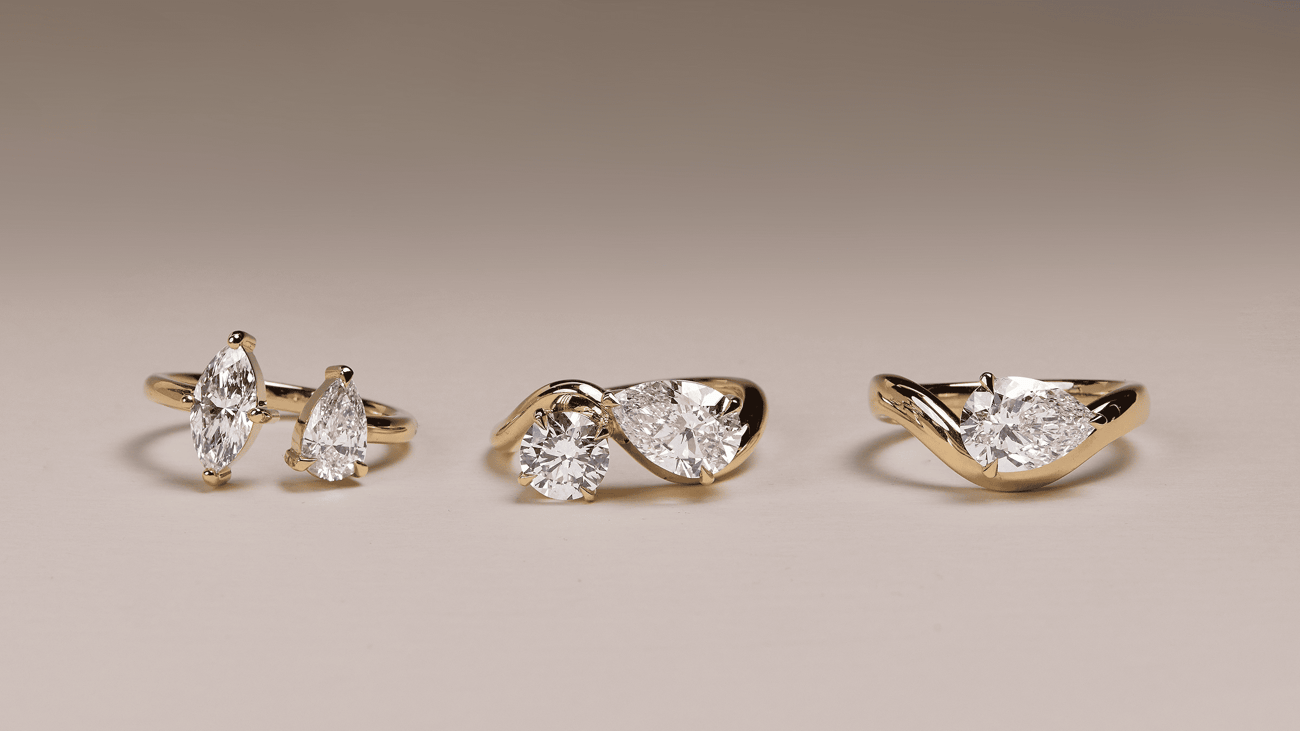
Retailers are responding accordingly. More brands now offer customizable, cost-efficient alternatives to traditional diamond jewellery, and even established players like Diamondere feature the best lab-grown engagement rings collections alongside their natural diamond offerings.
Lab-Grown Diamonds’ Competitive Edge
Synthetic diamonds are positioned at the intersection of affordability and luxury. They look like the natural stone, forged by fire and pressure in the depths of our planet, but come with a smaller environmental footprint and a far lower cost.
As of Q1 of 2026, a 1.0-carat D/VVS2 lab-grown diamond typically retails for $280–$320, while a comparable mined stone holds a wholesale baseline around $7,000. This level of quality, once rare and prohibitively expensive, is now standard in the lab-grown segment.
Production is also accelerating. AI-powered quality assessment systems can detect imperfections with up to 99.8% accuracy, while machine learning models optimize growth conditions. The result: faster output, greater consistency, and lower costs. Lab-grown diamonds now account for roughly 25% of the global market.
For the naysayers: lower prices don’t necessarily weaken the category; they segment it. Natural diamonds still dominate, holding a 75% share of global consumption. High-net-worth buyers continue to favor mined stones for their perceived rarity and long-term value.
Rather than replacing natural diamonds, lab-grown stones expand the market. They create new entry points for buyers and new revenue streams for retailers
How Lab-Grown Diamonds Reshape Jewelry Margins
The cost gap between natural and lab-grown diamonds is reshaping how jewellers set margins. Here are three key ways this shift plays out:
1. The Percentage Play
With mined diamonds, the jeweller must pay a large upfront fee to buy the stone because they are rare and costly to obtain. Because the cost is so high, they can only mark up the price by a certain amount before it becomes too expensive for anyone to buy.
Let’s say a jeweller buys a mined diamond for $8,000 and sells it for $10,000 as part of an engagement ring. This means a 20% margin. On the other hand, a lab-grown stone of the same size and clarity costs around $500. The final price of the ring can range from $2,000 to $2,500. No, that’s a 70-80% margin!
Even though the total sale price of the lab-grown diamond is much lower, the jeweller's margin is much higher.
2. Inventory Velocity
Margins are also shaped by how quickly inventory moves. A $20,000 mined diamond ring may sit for months (or longer), tying up capital. In contrast, a $3,000 lab-grown ring is more accessible and typically sells faster.
If a retailer sells multiple lab-grown pieces in the time it takes to move a single mined diamond, overall returns improve through higher inventory turnover and more efficient use of capital.
3. The Setting Markup
In diamond jewellery, the stone is only part of the value equation. The setting, craftsmanship, and design also drive pricing.
With mined diamonds, the high cost of the stone limits how much pricing power can be applied elsewhere. In lab-grown pieces, the lower stone cost shifts the value balance. Retailers can allocate more margin to design, branding, and materials, areas that often carry higher profitability.
No Reason for Worry
Lab-grown diamonds are not replacing natural stones; they’re just redefining how value is created and captured. Natural diamonds remain at the high end, but lab-grown stones are expanding the addressable market.
For retailers, the opportunity lies in higher margins, faster inventory turnover, and greater pricing flexibility. For investors, the shift signals a market moving toward segmentation rather than substitution.
The winners won’t be those who pick sides, but those who adapt their pricing, positioning, and inventory strategies to serve both.
About Investorideas.com - Big Investing Ideas
Investorideas.com is the go-to platform for big investing ideas. From breaking stock news to top-rated investing podcasts, we cover it all. Our original branded content includes podcasts such as Exploring Mining, Cleantech, Crypto Corner, Cannabis News, and the AI Eye. We also create free investor stock directories for sectors including mining, crypto, renewable energy, gaming, biotech, tech, sports and more. Public companies within the sectors we cover can use our news publishing and content creation services to help tell their story to interested investors. Paid content is always disclosed.
Learn more about our news, PR and social media, podcast and content services at Investorideas.com
https://www.investorideas.com/Investors/Services.asp
Follow us on X @investorideas @stocknewsbites
Follow us on
Facebook
https://www.facebook.com/Investorideas
Follow us on YouTube
https://www.youtube.com/c/Investorideas
Contact Investorideas.com
800 665 0411
This article is for informational purposes only and is not investment advice. See our full disclaimer.