Gold, silver and copper market updates we're bullish
Gold, silver and copper outlook turns bullish as structural deficits, strong demand and macro trends support higher prices across mining markets.
Gold, silver and copper market updates we're bullish
(www.investorideas.com Newswire)
Gold and silver have largely defied traditional safe-haven expectations during the
2026 Iran conflict, experiencing significant volatility and price declines rather
than consistent rallies. Gold fell over 10% and silver over 20% in
March 2026, often dropping when oil prices spiked as investors sold
assets, including gold, for liquidity amid a stronger US
dollar.
Copper prices have remained resilient during the war, often trading near record or multi-month highs due to tight
supply-demand fundamentals. While the conflict initially caused
volatility and supply chain disruption, prices have been supported
by fears of production cuts in Africa and Latin America, partly
driven by shortages of sulphur/ sulfuric acid used for leaching
copper.
Gold
Bond yields rising
Gold has an inverse relationship with US Treasury yields. As yields
rise, gold normally falls, as interest-bearing assets become more
attractive compared to gold, which offers neither interest nor a
dividend.
The opposite happens when yields fall,
normally.
Like gold, Treasuries are a haven during
geopolitical crises like the current war in the Middle East.
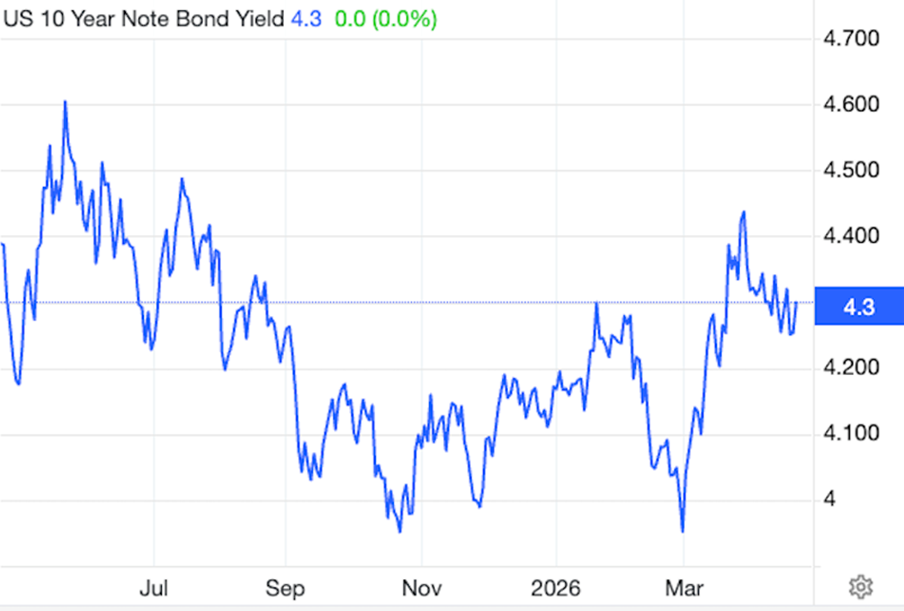
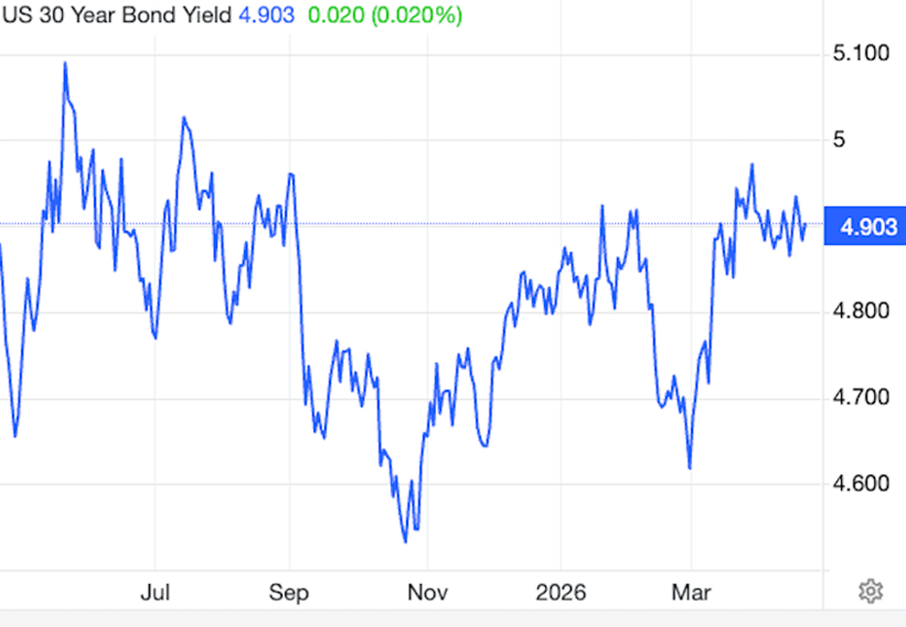
According to MSN, Treasury yields are surging as global buyers retreat from owning
US debt (One more thing to understand about Treasuries: Prices and
yields move in opposite directions. As demand for them falls, prices
dip and yields rise. As demand rises, prices go up and yields
fall).
MSN notes yields are climbing sharply as
geopolitical tensions, a $1.9 trillion deficit, and waning foreign
demand undermine their safe-haven status. China is selling
Treasuries at rates unseen since 2008.
The resulting
pressure threatens the dollar’s purchasing power, fuels
inflation risks, and may force the Federal Reserve into
controversial debt monetization (i.e. quantitative easing, where the
Fed buys Treasuries by printing money, at the risk of massive
inflation).
Noting that the Iran war closed the Strait of
Hormuz and disrupted oil supplies, driving inflation higher, The New
Republic says that crisis coincides with the Treasuries’
struggle to finance a $1.9 deficit without its usual base of foreign
buyers.The result is a surge in yields as investors sell off Treasurys,
reversing decades of safe-haven behavior during global crises.
The publication adds the erosion of the petrodollar paradigm and
the weaponization of the SWIFT system have further alienated
once-captive buyers. This shift suggests a longer-term weakening of
the dollar’s role in global finance, with implications for US
borrowing costs and fiscal stability.
However,
Seeking Alpha observes that rising yields in Japanese and German
bonds, hitting multi-decade highs, reflect a broader global
inflation cycle that predates the Iran war. Economist Lakshman
Achuthan warns that this upturn is driven by structural forces like
commodity price increases from industrial growth, not just oil
shocks. Such persistent inflation pressures could limit central
banks’ ability to ease monetary policy, further straining bond
markets worldwide.
The Fed’s response to rising
bond yields carries high stakes. Investopedia posits that, if private credit markets fracture, the Federal Reserve may
become the buyer of last resort, creating money to purchase
Treasurys and enable bank bailouts. While this would stabilize
finance capital, it would erode wages, savings, and the
dollar’s credibility, risking domestic austerity and
international debt crises. The Fed’s current wait-and-see
stance reflects uncertainty over whether inflation spikes are
temporary or entrenched.
Hedge against debt
Gold serves as
a primary hedge against rising global debt and deficits, tending to
perform strongly when governments run high deficits that risk
currency debasement and inflation. As debt levels rise, investor
confidence in fiat currencies dips, increasing gold’s appeal
as a safe-haven asset with no counterparty risk.
Historically,
high fiscal deficits and high debt-to-GDP ratios are strongly
correlated with rising gold prices, particularly in the 1970s and
from 2000 onwards.
As of early 2026, the trend of high
deficits, particularly in the US, is seen as driving further
long-term growth for gold.
Gold beats Treasuries
Central banks have increased gold reserves from 9% to
24% of total reserves since 2015, shifting away from US Treasuries
due to mounting debt fears.
Last year, central bank gold
reserves surpassed US Treasury reserve holdings, marking the first
time this has happened since 1996. According to the World Gold
Council, via Vaulted, central banks collectively own about 18% of all the gold ever
mined, or 38,214 tons. This gold was worth $4.6 trillion on April 7,
2026, prices.
The chart below shows the total value of
foreign treasury reserves vs. the total value of gold reserves held by central banks
since 2010.
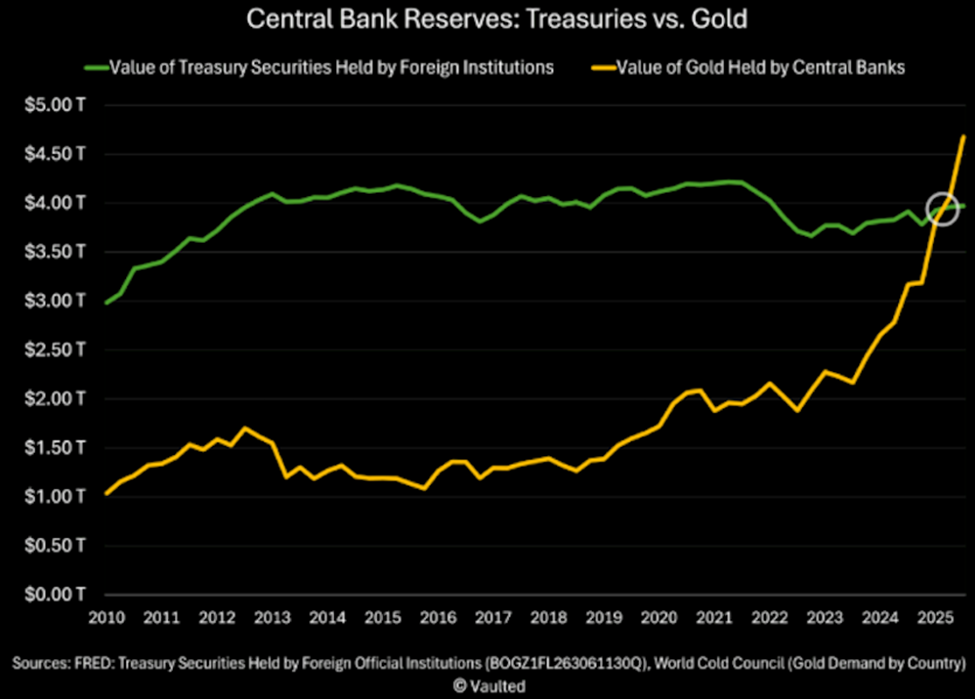
In the 2010s, Treasuries made up more than 30% of central bank
reserves. That number has now dropped to 23%, while gold’s
share has risen to 27%. In each of the last three years, central
banks have collectively purchased over 1,000 tonnes of gold (double
the annual average from the previous decade), states Vaulted.
Reasons
for such high levels of central bank buying include post-pandemic
inflation eroding confidence in the purchasing power of fiat
currencies; the deterioration of US fiscal health — rising
deficits are causing investors to worry about the country’s
ability to manage its debt; gold is a neutral asset to settle
transactions between nations, with no counterparty risk; Treasuries
are vulnerable to sanctions; and gold has traditionally outperformed
sovereign bonds and currencies during military conflicts and
financial crises.
“Simply put: Treasuries come
with strings attached. Gold does not.”
US gold-to-debt ratio falls to 2%
Despite the fact the United States owns the most gold
of all nations, 8,133 tonnes, the amount of gold reserves held by
the US Treasury as a proportion of government debt has shrunk to
just 2%.
Discovery Alert notes this is one of the lowest ratios in 90 years and highlights a
fundamental shift in America’s financial foundation:
The current 2% gold-to-debt ratio stands in stark contrast to
America’s financial past. During World War II, US Treasury
gold reserves accounted for approximately 40% of the
nation’s debt, providing substantial backing to government
obligations. By the 1970s, this ratio had declined but still
maintained a relatively robust 17% of government debt…
As
government debt approaches $40 trillion, the proportional backing
of this debt with hard assets has diminished to historically low
levels…
Significant gold accumulation by other
nations, particularly China and Russia, has shifted the global
balance of monetary power.
According to some analysts, China may have already surpassed US
gold holdings, though official figures remain disputed…
Global central banks collectively own less than 20% of their
total assets in gold—a significant decline from historical
peaks of approximately 75% in the early 1980s…
Countries like Russia have increased their gold reserves
substantially over the past decade, potentially positioning
themselves for a monetary system less dependent on the US
dollar.
Buy the dip
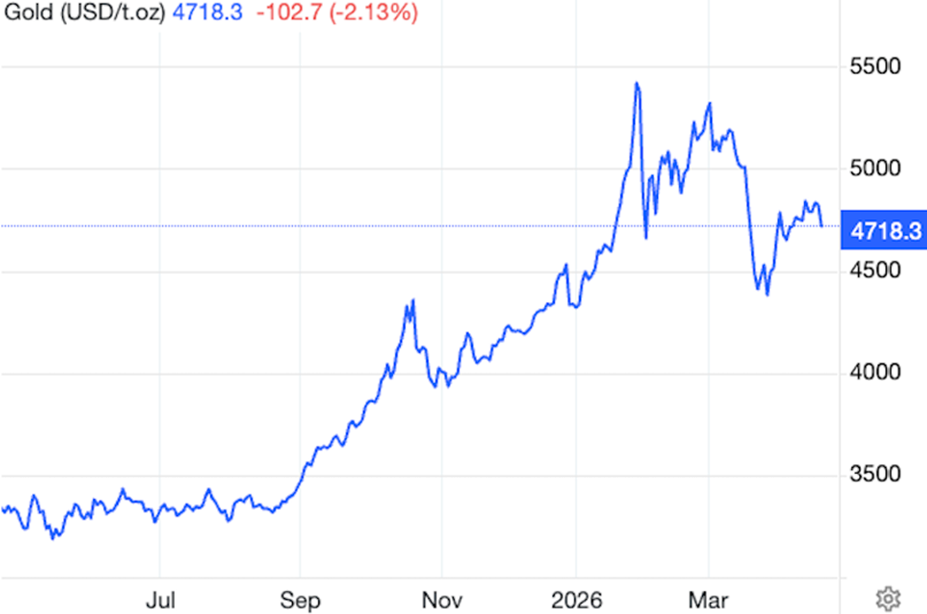
Gold’s pullback from a Jan. 28
record-high $5,589/oz has created an attractive entry point, said
Barclays Bank analyst Aja Rajadhyaksha, via Investing.com. His justification is based on three reasons:
“The
combination of geopolitical risk, persistent central bank buying,
the inflation spike from the oil shock, and the fiscal effect of the
conflict should all support gold,” he said.
Contrary to the mindset at the beginning of the conflict,
Rajadhyaksha does not anticipate central bank interest rate hikes in
2026.
Another analyst quoted by Kitco News is also in the dip buyers’ club.
Nitesh Shah, head of commodities and macroeconomic research at
WisdomTree, said the recent selloff — which has seen gold
prices drop more than $1,000 from peak levels — appears
largely disconnected from macroeconomic fundamentals and instead
reflects a combination of positioning shifts and forced
liquidations.
Shah added it’s not usual for gold to fall
initially during geopolitical events before resuming its upward
trend. Indeed, this is precisely what we see happening in the above
spot gold chart.
Shah is skeptical that central banks
will raise interest rates to combat inflation due to the risk of
triggering a recession. He said persistent geopolitical tensions
will remain a key pillar of support for gold prices.
Looking
beyond gold, the analyst said the current environment is broadly supportive for
commodities as a whole, particularly as the global economy moves
into a late-cycle phase marked by rising inflation risks and
supply constraints.
“Late-cycle economic dynamics
tend to be positive for commodities,” he said, noting that
energy, agriculture and base metals are now catching up after
precious metals led the rally earlier in the cycle.
Turning to gold supply, an AI Overview says that mined gold
production is currently failing to keep pace with demand,
contributing to a structural deficit that is supported by high
consumer demand, central bank buying, and dwindling reserves. While
mine production reached a record high of 3,672 tonnes in 2025, total
demand continues to outrun this supply, creating a long-term,
tightening supply scenario.
According to the World
Gold Council, 2024 mine production reached 3,661.2 tonnes, with gold
demand hitting 4,974 tonnes. 4,974t of demand minus 3,661.2t of
production left a deficit of 1,312.8t. Only by recycling 1,370
tonnes of gold jewelry could demand be satisfied.
This is our definition of peak gold. Will the gold mining industry
be able to produce, or discover, enough gold, so that it’s
able to meet demand without having to recycle jewelry? If the
numbers reflect that, peak gold would be debunked. We’ve been
tracking it since 2016, and it hasn’t happened yet. Global
mined production has largely plateaued over the past five to seven
years.
And while 2025 saw record gold production, mining
faces a potential cliff after 2025 as the pipeline of large-scale
projects shrinks.
Causes of the mined deficit includes
dwindling reserves, a lack of new discoveries, declining ore
quality, and resource nationalism. For example, Burkina Faso plans
to increase its stake in the Kiaka gold mine from 15% to 40% via a
government decree, it was recently reported.
Identified, economic gold reserves
are estimated at only about 20 years’ worth of mining at
current production rates (approx. 59,000 tonnes remaining), states
The Oregon Group.
The industry is
increasingly relying on junior explorers to fill the gap in finding
new deposits. However, the long-term trend points towards a
sustained tightening of gold supply due to geological scarcity and
the long lead times required to bring new mines into
production.
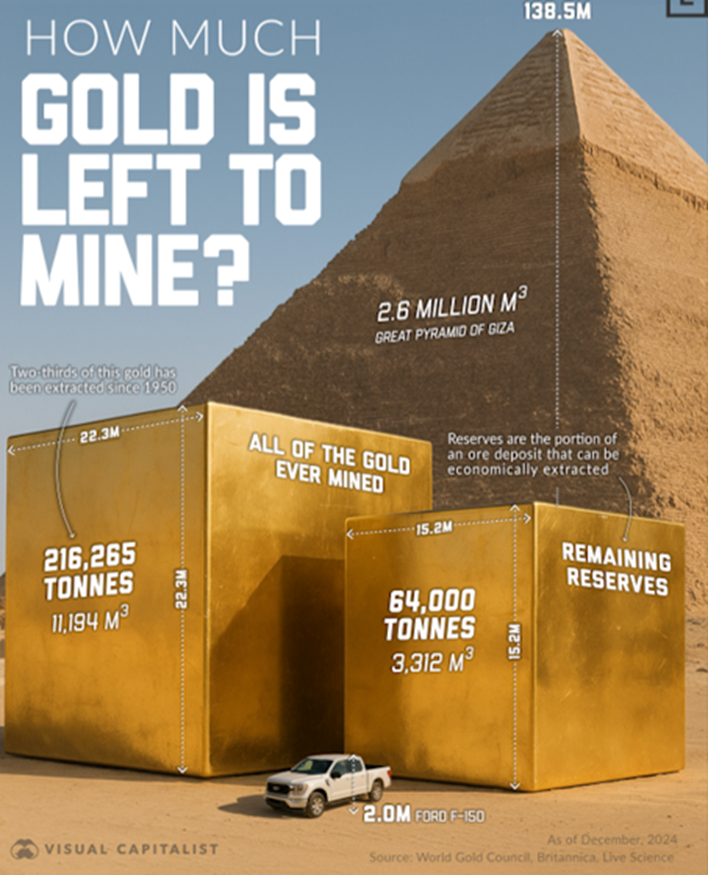
A November 2025 infographic finds roughly 216,000 tonnes of gold have been mined, with
about 64,000t left underground.
One way major gold miners could increase their reserves without
simply buying the reserves of other companies through M&A, which
does nothing to increase global gold reserves, is
for them to consolidate gold districts.
Newmont Mining
(NYSE:NEM) for example significantly consolidated its gold district
holdings in Nevada, most notably through the creation of Nevada Gold Mines (NGM), a joint venture with Barrick Mining (NYSE:ABX), and previously by
acquiring major competitors.
More recently, Agnico Eagle
Mines (NYSE:AEM) announced a plan to consolidate properties in the Central Lapland
Greenstone Belt of northern Finland, through the 100% acquisition of Rupert Resources and Aurion
Resources; and the purchase of a 70% interest in Fingold Ventures
held by B2Gold (TSX:BTO).
Together with the 30% interest
held by Aurion, the deal would result in Agnico Eagle owning a 100%
ownership interest in the Fingold JV, and “would establish
Finland as a multi-asset, multi-decade regional platform within
Agnico Eagle’s portfolio, with a pathway to become an
approximately 500,000-ounce annual gold production hub within the
next decade,” AEM states.
Silver
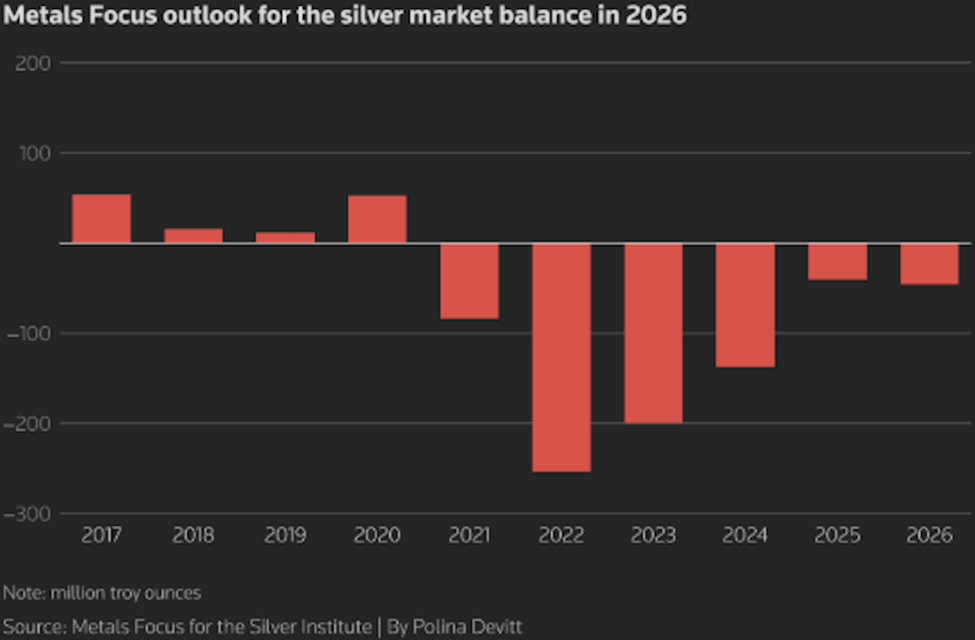
There is a significant, ongoing structural shortage of
physical silver in 2026, marking six consecutive years of deficits
where industrial and investment demand outweighs supply. While
exchange-traded paper silver exists, physical silver is increasingly
scarce, with major inventories in London, New York, and Shanghai
experiencing rapid depletion.
Analysts estimate the
cumulative supply deficit since 2021 at roughly 820 million ounces
— nearly a full year of global mine production, gone. This
year’s deficit is projected at 67Moz.
Record demand
from industrial sectors, particularly solar panels, electronics and
electric vehicles, is outpacing flat mine supply.
The
three largest silver inventories (Shanghai, COMEX and LBMA) are
dropping simultaneously, with nearly a billion ounces vanishing from
visible stocks since 2021.
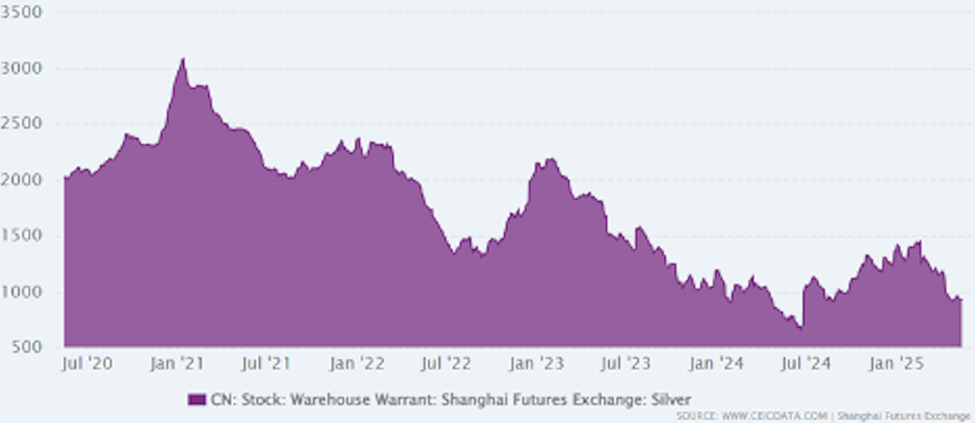
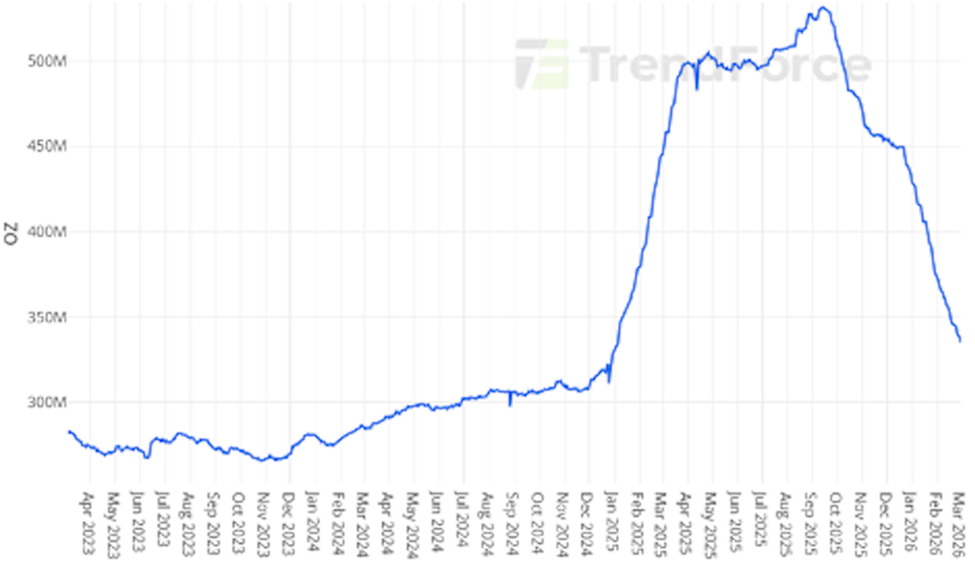
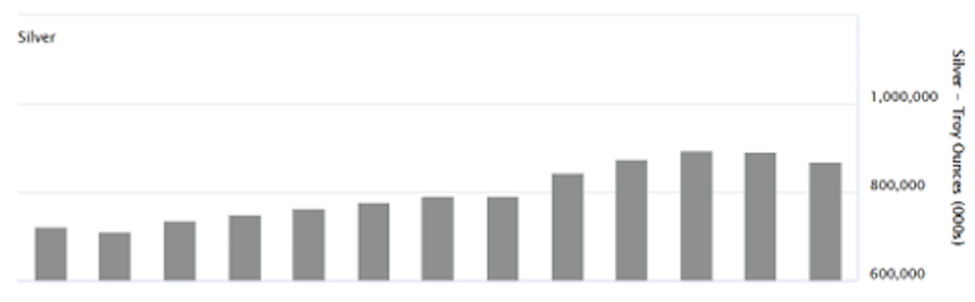
Strong demand has led to shortages in physical silver products (bars and coins) and tight supply in the physical market.
The silver shortage is real — Richard Mills
Behind the silver deficit
Key findings as of
early 2026, by the Silver Institute:
-
Because mine output and recycling combined still fail to meet
demand, the gap is primarily filled by clearing out global
exchange-traded products (ETPs) and COMEX warehouse stocks.
-
The shortage is driven by record industrial demand —
particularly in solar energy, electronics, and electric vehicles
— colliding with stagnant mine supply of around a billion
ounces.
- 70 to 75% of silver is produced as a byproduct of lead, zinc and copper mining, meaning miners can’t easily increase silver production in response to higher prices.
As for the 2026 outlook, Reuters reported last week that industrial demand for silver is seen down 3%
to 640Moz, but coin and bar demand should rise by 18% to 258Moz.
The
publication cites data from the Silver Institute and consultancy
Metals Focus, which found that 762 million ounces have been drawn
from inventories since 2021, raising the risk of a renewed liquidity
squeeze despite weaker demand expectations.
It notes
silver used in jewelry, electronics, EVs, solar panels, and for
investment, is down 35% following a 147% surge in 2025 and driving
prices to a record-high $121 an ounce in January.
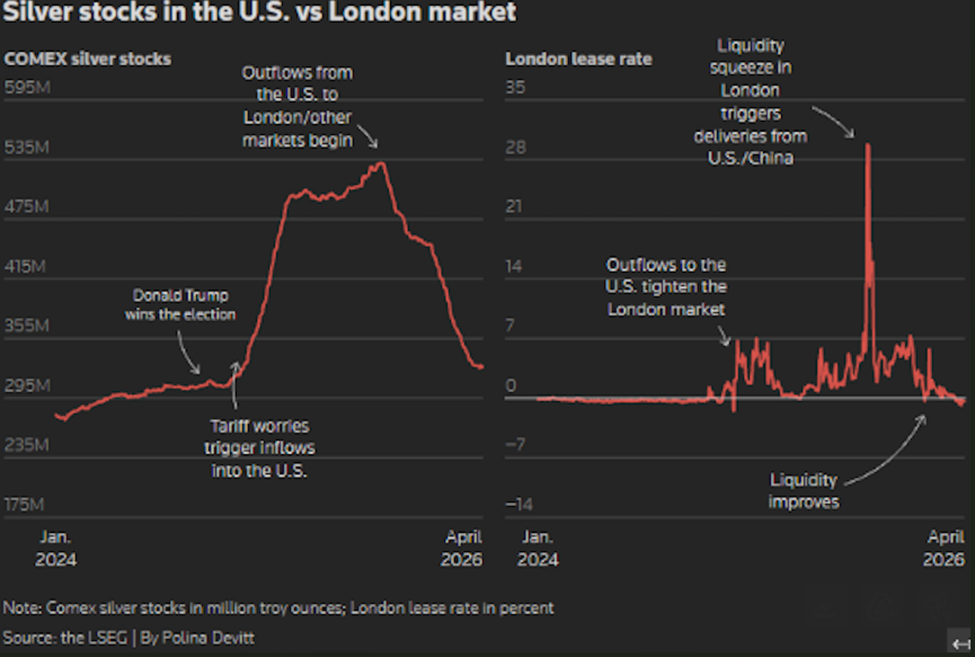
The
downside of the 2025 silver run was an October liquidity squeeze in
the benchmark London market, caused by months of inflows to US
inventories and silver-backed exchange-traded products (ETPs),
alongside a spike in physical demand.
While liquidity has
improved as metal flowed back from the US, ETPs saw outflows and
Indian demand eased, said Reuters, before quoting Philip Newman,
managing director at Metals Focus, which prepared the research for
the Silver Institute: “Lease rates in London have largely
normalised, but risks of another liquidity squeeze this year
remain.”
China
One can’t write intelligently about
the silver market without mentioning China, the world’s
largest silver consumer.
Beijing is reportedly pulling silver from global markets at the fastest pace in eight years.
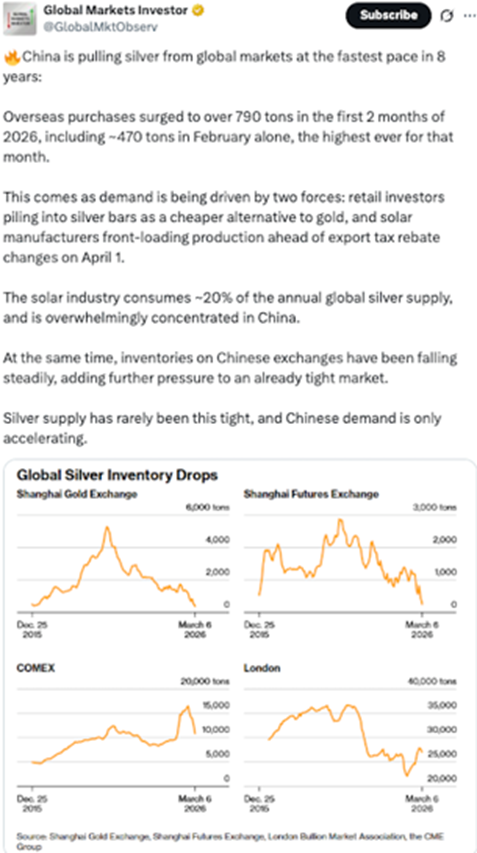
According to Bloomberg, China’s silver imports hit an all-time high in March,
fueled by demand from retail investors and the solar industry. The
month saw 836 tons cross China’s docks, compared with a
10-year seasonal average for March of about 306 tons.
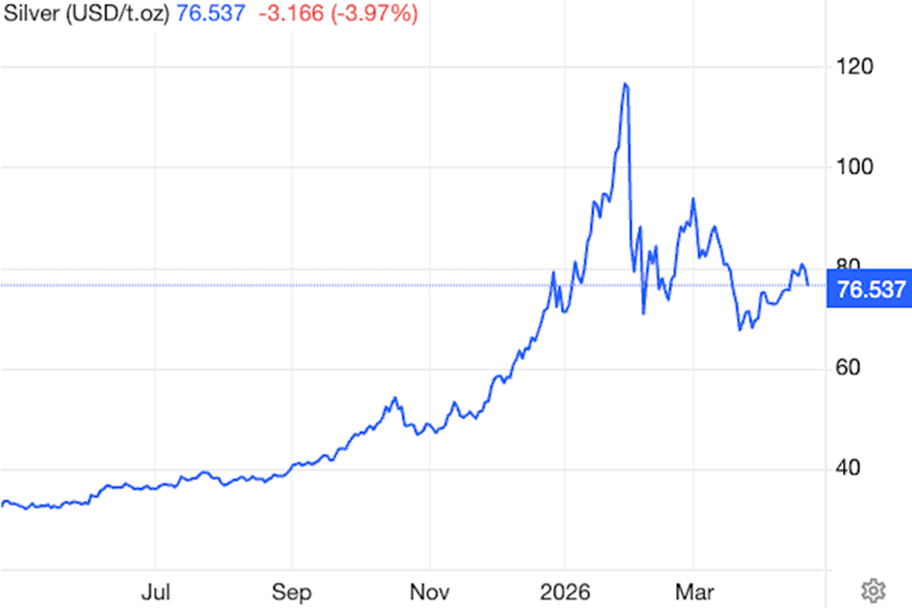
Scrambling for high-grade ground
While silver is down about $40 from the January record
high, the precious metal has been consolidating its gains in a band
around $75 to $85 through the first four months of the year. (USA
News Group).
The 150% year-on-year run has producers
scrambling for high-grade ground. Past-producing ground that was
uneconomic at silver below $20 per ounce a decade ago looks very
different at $80.
Copper
The copper industry is entering a
structural deficit, with demand from electrification and AI expected
to outpace new mine development. Recycling is essential for filling
this gap, but it is not currently capable of meeting the entire
deficit on its own.
Why we’re running out of copper — Richard Mills
While the copper market was roughly balanced in 2025, meaning that refined production met consumption, mine supply was severely disrupted and will likely create a deficit in 2026, states the International Institute for Strategic Studies (IISS).
A significant long-term deficit is projected, potentially exceeding
6 million tonnes annually by the early 2030s. Total output from
copper mines in 2025 was 23 million tonnes, according to the
USGS.
A new study released on Jan. 8 by S&P Global Market Intelligence and
S&P Global Energy found that copper supply is expected to fall
10Mt short of demand by 2040, putting at risk industries such as
artificial intelligence, defense spending and
electrification.
The shortage would be 23.8% shy of
the projected demand of 42Mt, even as copper recycling doubles to
10Mt. AOTH research has found that copper supply has not been able
to meet demand without recycling for the past several
years.
“Here, in short, is the quandary:
copper is the great enabler of electrification, but the accelerating
pace of electrification is an increasing challenge for
copper,” Daniel Yergin, vice chairman at S&P Global, who
co-chaired the study, said in a statement. “Economic demand,
grid expansion, renewable generation, AI computation, digital
industries, electric vehicles and defense are scaling all at
once — and supply is not on track to keep
pace.”
An earlier (November 2025) blog post by Wood Mackenzie brings its forecast five years ahead of S&P Global, with
the consultancy expecting global demand for copper to surge 24% and
reach 43Mtpa by 2035.
It says four emerging demand
disruptors will add 3Mtpa, almost doubling growth from traditional
sectors. The four sectors underpinning a stronger outlook for
the copper market are: the rapid expansion of data centers;
geopolitical tensions ratcheting up spending on defense and boosting
infrastructure resilience; low-carbon energy projects consuming
record amounts of copper; and Southeast Asia and India becoming
major consumers of copper as they rapidly industrialize.
Data centers: Gluttons for power, water and minerals Part I
Data centers: Gluttons for power, water and minerals Part II
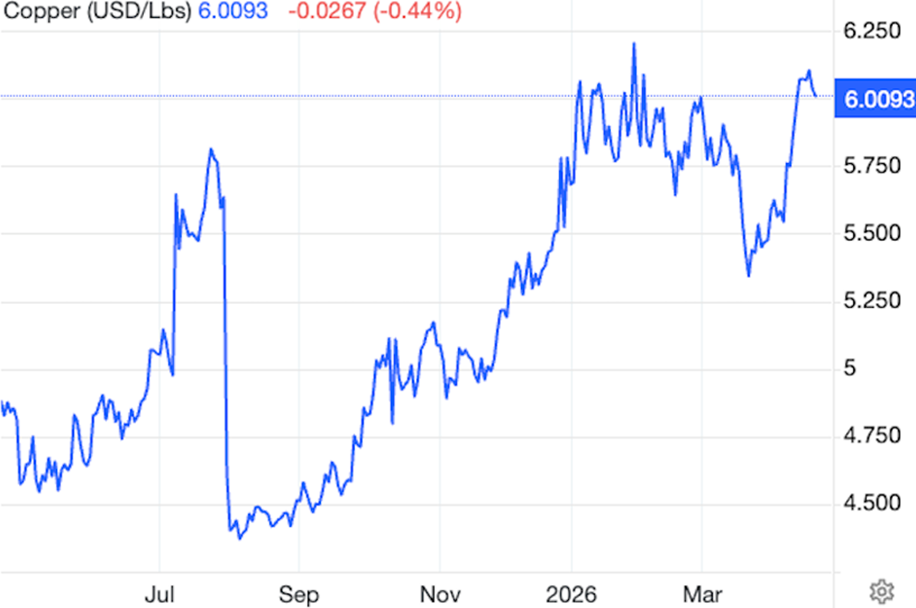
Copper has been volatile for the duration of the now seven-week war
in Iran, falling as low as $5.33/lb on March 20 before rebounding to
the current $6.00 as investors stayed cautious ahead of further
US-Iran peace negotiations.
Coming off four weeks of
gains, the base metal fell 0.5% Monday to settle at $13,275/tonne
($6.02/lb) on the London Metal Exchange.
But prices are supported by improving demand sentiment in China and
a sharp drawdown in exchange inventories: Shanghai Futures Exchange
stockpiles are down nearly 200,000 tons since the March 13 peak.
According to the Financial Post, The major risk for metals is a prolonged closure of the [Hormuz]
strait, which would magnify the energy shock already rippling
through the world economy. That could force central bankers into a
more hawkish stance, hitting global manufacturing and damaging
demand for industrial commodities.
Tavi Costa, former principal at Crescat Capital, says
“Copper has shown remarkable resilience despite the broader
volatility across most commodities.”
For proof,
check out the Bloomberg Commodity Index’s (BCOM) three-month
chart.
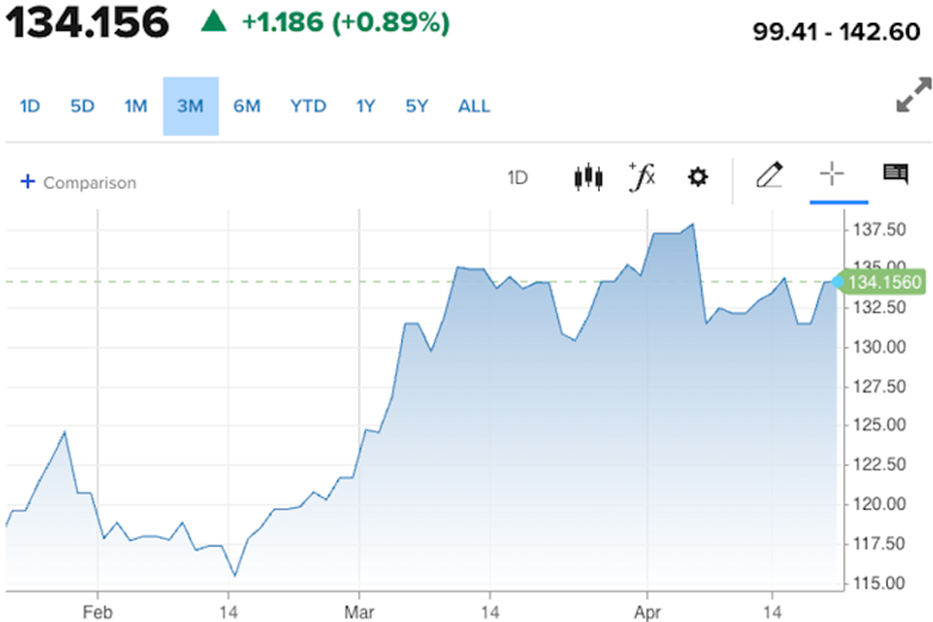
Costa goes on to say in a post on X: “The metal precisely
retested its breakout level, which now appears to be holding as
strong support. In my view, this sets the stage for the next move
higher. Both the technical and fundamental backdrop remain
incredibly constructive.”
Like for silver, to
understand the copper market we need to look at China, the
world’s largest consumer of the ubiquitous industrial
metal.
Earlier this month, a researcher at state-owned
China Minmetals said Chinese refined copper consumption could grow
by an average 3.7% annually through 2035. In the company’s
“most realistic” scenario, that would mean 22.9 million
tonnes, up 43% from 16Mt in 2025. (Kitco News)
In that scenario, China in 2035 would account for 55%
of total refinery production of 29Mt in 2025, per the USGS.
China’s
rising copper consumption comes at a time when copper refining is
challenged due to the war in Iran.
Among the commodities
the closure of the Strait of Hormuz has affected are sulfur and
sulfuric acid.
According to Argus Media, Roughly half of global seaborne sulphur trade transits the strait
of Hormuz. With Middle Eastern refinery operations disrupted and
shipping largely halted, global sulphur availability has tightened
sharply.
Sulfuric acid is a core reagent in the heap leaching and
solvent extraction–electrowinning (SX/EW) process used to
produce copper from oxide ores and certain secondary sulfide ores.
This hydrometallurgical method is essential for the economic
recovery of low‑grade deposits and is widely employed across major
copper‑producing regions worldwide.
Sulfur chokepoint threatens critical minerals supply — Richard Mills
Heap-leach operations supply roughly one-fifth of the world’s
refined copper, an amount approximating 4 million tonnes per year.
According to the USGS, global refined copper production last year
was 29 million tonnes, so heap leaching using sulfuric acid
represents almost 14% of the total.
Sulfuric acid is a
core reagent in the heap leaching and solvent
extraction–electrowinning (SX/EW) process used to produce
copper from oxide ores and certain secondary sulfide ores. This
hydrometallurgical method is essential for the economic recovery of
low‑grade deposits and is widely employed across major
copper‑producing regions worldwide.
Heap-leach operations
supply roughly one-fifth of the world’s refined copper, an
amount approximating 4 million tonnes per year. According to the
USGS, global refined copper production last year was 29 million
tonnes, so heap leaching using sulfuric acid represents almost 14%
of the total.
Among the top counties using sulfuric acid
for copper leaching are the United States, Chile, Peru, Mexico, the
Democratic Republic of Congo (DRC), Zambia, China, Kazakhstan and
Australia.
Unsurprisingly, Chile is the top copper
producer and the largest user of sulfuric acid for copper heap
leaching, with a significant portion of its cathode production
derived from solvent extraction and electrowinning (SX/EW),
a two-stage hydrometallurgical process used to produce
high-purity copper from oxide and low-grade ores.
Heap-leached
cathodes account for roughly 40% of Chile’s total copper
exports.
Ranked second in heap leach operations, the US
uses large-scale heap and dump leaching in Arizona, including at the
Morenci, Bagdad and Sierrita mines.
Peru, the
third-biggest copper miner, uses hydrometallurgical processing,
while Mexico operates several major heap leaching projects including
Cananea.
China has invested heavily in heap leaching
technologies for low-grade deposits and high-mud copper oxides,
while Kazakhstan is active in in-situ leaching (ISL) for copper and
uranium.
Australia uses bioleaching and heap leaching,
for example at the Girilambone and Mount Leyshon mines.
Sulfur
is used to make sulfuric acid used in African countries to heap
leach copper. When these countries run out of sulfur/ acid they will
no longer be able to extract copper, causing a shortage.
The
Central African Copperbelt (CACB) produces around 6 million tonnes
per year of sulfuric acid, much of which is used in the DRC —
Africa’s largest copper miner — for high-grade oxide
leaching.
Africa is particularly exposed to the war in
Iran. According to Argus Media, nearly all sulfur imported by
southern African buyers last year originated in the Middle East.
The
CACB imports roughly 2Mt/yr of sulfur to make ~6Mt/yr of sulfuric
acid for oxide copper leaching. An additional 2.5Mt/yr of acid is
generated by regional copper smelters processing concentrates.
Argus notes Higher acid prices directly raise copper production
costs in one of the world’s fastest-growing supply
regions.
On April 15 Reuters ran with the headline ‘Congo copper and cobalt miners cut chemical use as
Iran war disrupts supplies’.
A 2,000-tonne sodium
metabisulfite (SMBS) order was canceled, while another 1,800-ton
shipment was withdrawn earlier in April, despite contracts being
signed, an anonymous source said.
An analyst at CRU, a
consultancy, noted that premiums for sulfuric acid and SMGS shipped
through Tanzanian port Dar es Salaam have almost doubled since the
war began, raising costs for miners. Ship rerouting and freight
availability have made the problem worse.
“What
used to take you three months now takes you four, six months,”
said mining chemicals supply-chain consultant Isabel Ramirez.
“There is a heightened risk of shortages.”
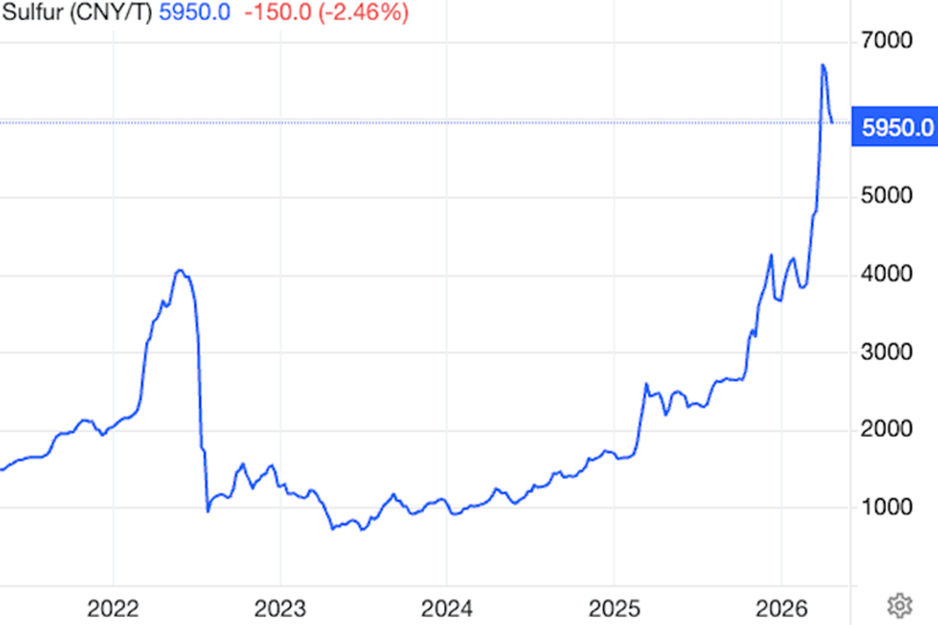
With
much of the world’s sulfur supply trapped in the Persian Gulf,
sulfur prices have reached record highs — approaching 7,000
Chinese yuan per tonne on March 30 before slipping back to the
current 5,950.
The sulfur supply squeeze has prompted China, the world’s
largest sulfuric acid producer, to ban exports in May. Turkey has
already done so and India is considering doing the same,
said Argus via Reuters.
Blogger Robby Pontecorvo wrote in Medium on March 24 that pressure is building in copper processing
because North America still doesn’t have enough refining
capacity to handle its own output. All the copper produced in
British Columbia, for example, is shipped to China for processing,
with the end products sent back to us.
Why Canada and the United States need more smelters — Richard Mills
He further notes that demand is “layering”, with AI
stacked on renewables which is stacked on EVs. Defense adds another
layer.
Supply is much slower to respond, with a new
copper project taking 7-10 years in the most optimistic scenario.
Global estimates point to around 80 new mines needed by 2030.
So, you’ve got a market where demand is starting to lean
forward, and supply is still locked into a slower cycle. That
mismatch doesn’t show up immediately in price. It shows up
in how tight things feel at the margins.
Lately, major copper miners are trying to fix the supply problem
through mergers and acquisitions. We saw this for example through
Anglo American’s (LSE:AAL) $54 billion merger with Teck
Resources.
The problem, writes George Hay, a columnist for Reuters, is that despite near-record copper prices, they aren’t high
enough to induce mass production. That’s because inflation has
pushed up production costs even faster.
The IEA reckons that the capital expenditure required to get new
supply up and running in Latin America, the world’s key
production location, has increased by 65% since 2020. That’s
the case even on “brownfield” sites…
To
make an acceptable return on such a site, big miners would require
a copper price of over $12,000 per ton, according to one mining
investor. Throw in the fact that it takes 17 years to get a mine
from discovery to production, and that permitting is getting
harder, and it’s easy to see why bosses are generally
reluctant to put much more money in the ground.
But there is one group of mining companies that is eager to explore
for the next big discovery, and that is copper juniors. Remember,
juniors own the mineral deposits that will become the next mines.
Last
week Mining.com reported that exploration spending in British Columbia — the
nexus of copper production in Canada, and where numerous copper-gold
and copper-molybdenum deposits are yet to be developed — set a
new record last year:
Exploration and evaluation expenditures in the province hit C$751
million ($548 million) in 2025, a 36% increase from 2024,
according to the latest British Columbia mineral and coal
exploration survey released this week by the EY consulting firm…
Copper’s
emergence as BC’s top exploration target – a first
– drove the increase in activity. Spending on the red metal
climbed to C$384 million, accounting for just over half of total
exploration investment and surpassing gold, long the dominant
focus in BC.
The shift reflects growing confidence in
long-term copper demand tied to electrification, infrastructure
buildout and the energy transition, as well as the
province’s endowment of large porphyry systems.
Conclusion
The war in Iran
has not resulted in a spike in gold and silver prices, contrary to
conventional wisdom that precious metals are a safe haven in times
of extreme geopolitical tension.
For gold, this is
primarily due to rising Treasury yields. Bond prices are dropping
and yields are climbing because foreign investors are hesitant to
buy US government bonds because of high debt levels. The trend of
high US deficits is seen as driving further long-term growth for
gold.
Central bank buying continues to underpin gold
prices. Last year, central bank gold reserves surpassed US Treasury
reserve holdings, marking the first time this has happened since
1996.
Mined gold production is currently failing to
keep pace with demand, contributing to a structural deficit that is
supported by high consumer demand, central bank buying and dwindling
reserves.
Analysts do not believe central banks will
raise interest rates to quell inflation driven by high oil prices;
this removes a major risk to gold prices. Of course, the longer the
war goes on, and the higher inflation climbs, the preferred monetary
course of action could change.
Silver is entering its
sixth year of deficits. Record demand from industrial sectors,
particularly solar panels, electronics and electric vehicles, is
outpacing flat mine supply.
The three largest silver
inventories (Shanghai, COMEX and LBMA) are dropping simultaneously,
with nearly a billion ounces vanishing from visible stocks since
2021.
Silver demand has rarely been this tight, and
Chinese demand is only accelerating. China’s silver imports
hit an all-time high in March, fueled by demand from retail
investors and the solar industry.
Copper mine supply was
severely disrupted last year and will likely create a deficit in
2026. A significant long-term deficit is projected, potentially
exceeding 6 million tonnes annually by the early 2030s.
The
bull case for copper is bolstered by tight markets for sulfur and
sulfuric acid, the latter used in metals refining.
When
copper-mining countries such as Chile, Peru, Australia, and those in
the Central African Copperbelt run out of sulfuric acid they will no
longer be able to extract copper, causing a shortage of refined
copper.
China will ban exports of sulfuric acid on May 1,
Turkey has already banned the reagent and India is considering
it.
Major mining companies are trying to address the
copper supply problem through M&A, but this does nothing to
increase the total supply; it just transfers the reserves from the
acquiree to the acquirer.
Despite near-record copper
prices, they aren’t high enough to induce mass copper
production. That’s because inflation has pushed up production
costs even faster.
The threshold necessary to justify
construction cost is currently pegged at $5.50 to $6.50/lb.
Our
analysis of gold, silver and copper shows that Nitesh Shah, head of
commodities and macroeconomic research atWidomTree, is right when he
says that the current environment is broadly supportive of
commodities, particularly as the global economy moves into a
late-cycle phase marked by rising inflation risks and supply
constraints.
Richard (Rick) Mills
aheadoftheherd.com

Check out the Exploring Mining podcast at Investorideas.com with host Cali Van Zant for the latest mining stock news and insightful interviews with top industry experts
Recent episode:
A New Era of Supply Shocks are Here: Axel Merk Shares Insight on Gold, Silver & Miners
https://www.youtube.com/watch?v=KQRyiswZSyc
Research mining stocks at Investorideas.com free stock directory
https://www.investorideas.com/Gold_Stocks/Stocks_List.asp
Sign up for free stock news alerts at Investorideas.com:
https://www.investorideas.com/Resources/Newsletter.asp
About Investorideas.com - Big Investing Ideas
Investorideas.com is the go-to platform for big investing ideas. From breaking stock news to top-rated investing podcasts, we cover it all.
Mining stocks -Learn more about our news, PR and social media, podcast and content services at Investorideas.com
https://www.investorideas.com/Investors/Services.asp
Follow us on X @investorideas @stocknewsbites
Follow us on
Facebook
https://www.facebook.com/Investorideas
Follow us on YouTube
https://www.youtube.com/c/Investorideas
Contact Investorideas.com
800 665 0411

Gold-MiningStocks.com - investing ideas in gold and mining stocks
Like Gold Stocks? View our Gold / Mining Stocks Directory
This article is for informational purposes only and is not investment advice. See our full disclaimer.